Home / For developer relations teams
For developer relations
Catch the technical conversations you'd miss
Social listening for developer relations teams. Sniffington searches public communities for posts about your product, docs and integrations, keeps the questions, bugs, comparisons and wrong claims, rules out the namesakes, and alerts the team that owns each one.
Start free See supported platforms
Free for one brand. No card.

What it does for a DevRel team
Catch technical questions
A question about your API, SDK or docs, three levels down a thread, found while the asker still reads replies.
What you getPosts tagged Question, most urgent first, each linked to its thread.
Spot bugs and misinformation
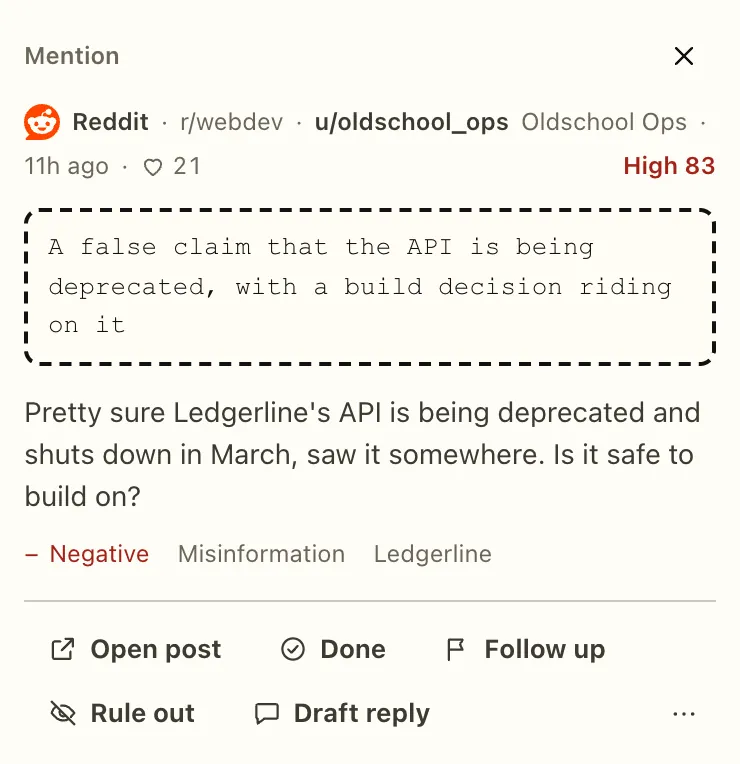
A crash report, a docs gap or a wrong claim about your product, before it becomes the accepted answer.
What you getBug report and Misinformation categories, routed to the channel that owns them.
Watch comparisons and alternatives
When developers weigh you against another tool, or ask what to use instead.
What you getPosts tagged Comparison, with the thread behind each.
Your support inbox is not where developers talk
Developers discuss tools in threads about something else: a Hacker News comment three levels down, an issue in a project that uses yours, a Stack Overflow question your docs should have answered, a post that links your docs without naming you. Sniffington searches names, domains and the links inside posts.
Public communities
Sniffington
Searches on a schedule, reads each post, and rules out the ones about something else.
One filtered feed
Each kept post has a category, a sentiment and an urgency score, with a reason on every post it rules out.
Triage
Catch questions, bugs and docs gaps
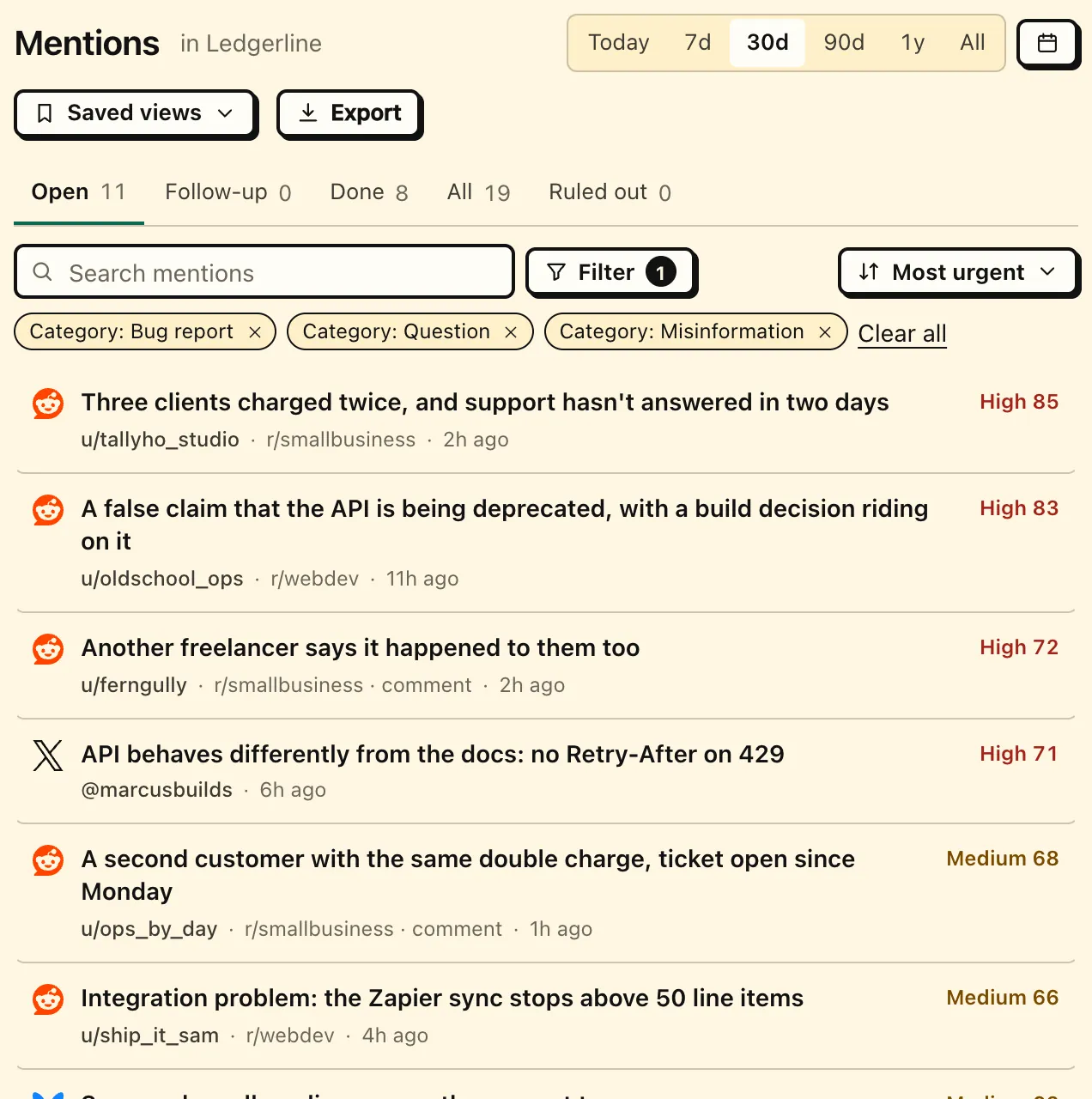
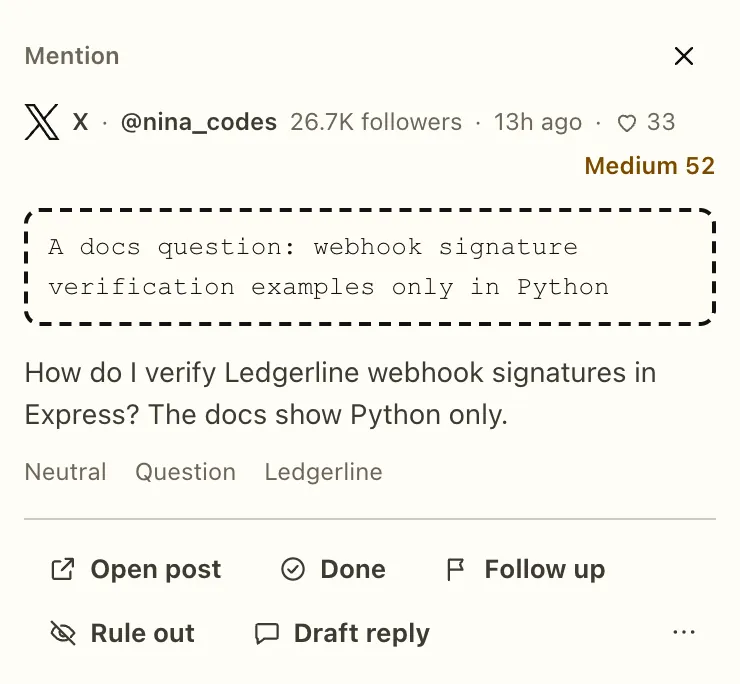
Each kept post gets a category: Question, Bug report, Feature request, Comparison, Misinformation and more. Filter to Question and Bug report for the threads that need an answer.
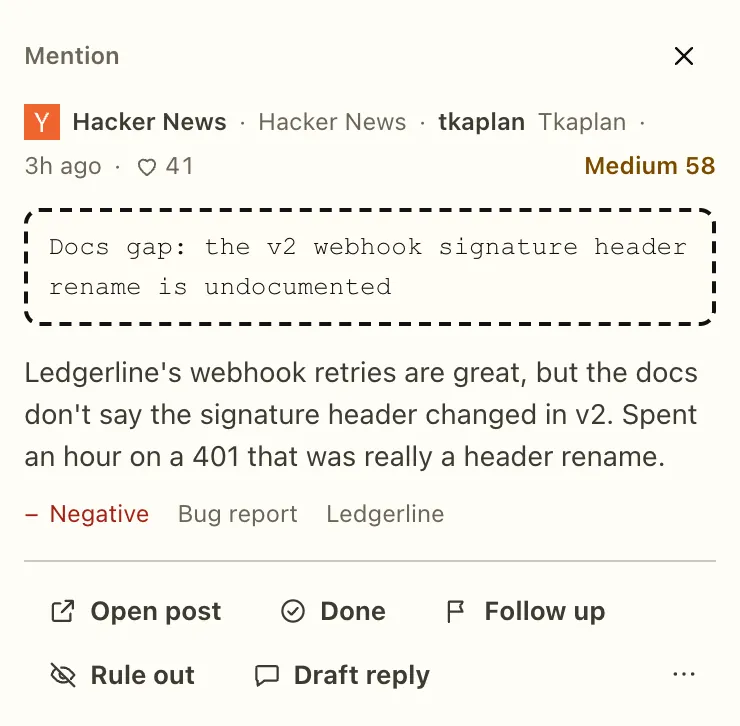
These conversations happen outside your support channels, in a GitHub issue, a Stack Overflow question or a thread about something else, and they often show where documentation or onboarding falls short: a header rename nobody wrote down, an example in one language only.
Comparisons
Know when developers compare you with another tool
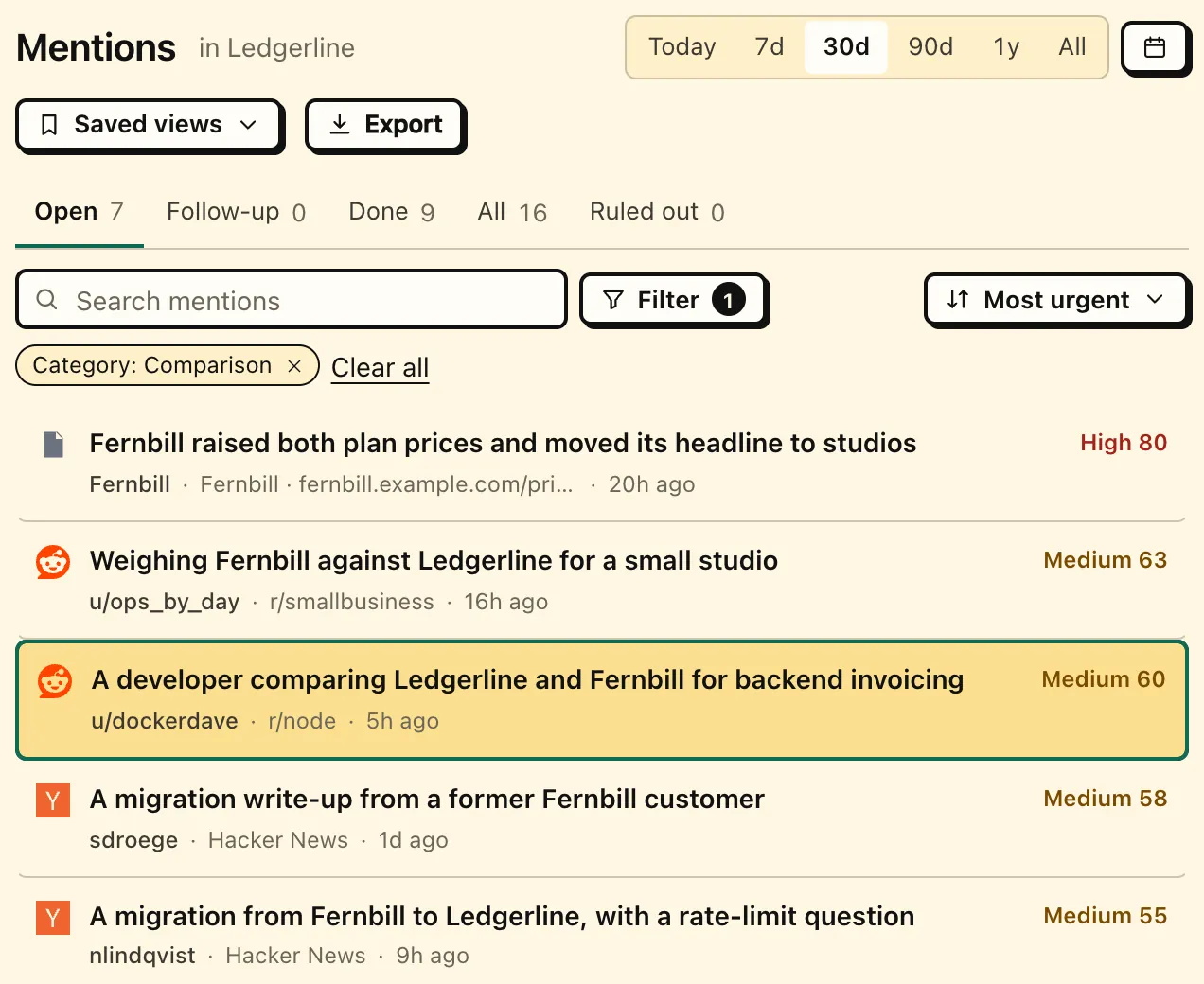
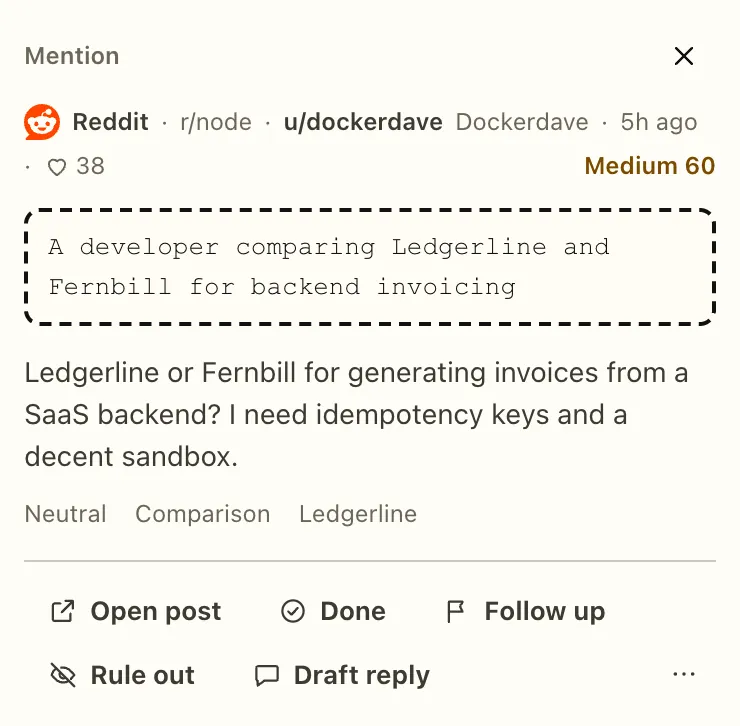
Keep competing tools in a Competitors group and phrases like "[tool] alternative" or "[tool] vs [tool]" in a topic group. Developers choosing a tool ask in public, and those threads arrive beside your own mentions tagged Comparison.
They show what developers weigh: idempotency keys, a sandbox, rate limits. Material for your docs, your positioning and the product team.
Start monitoring your product Free for one brand. No card.
Relevance
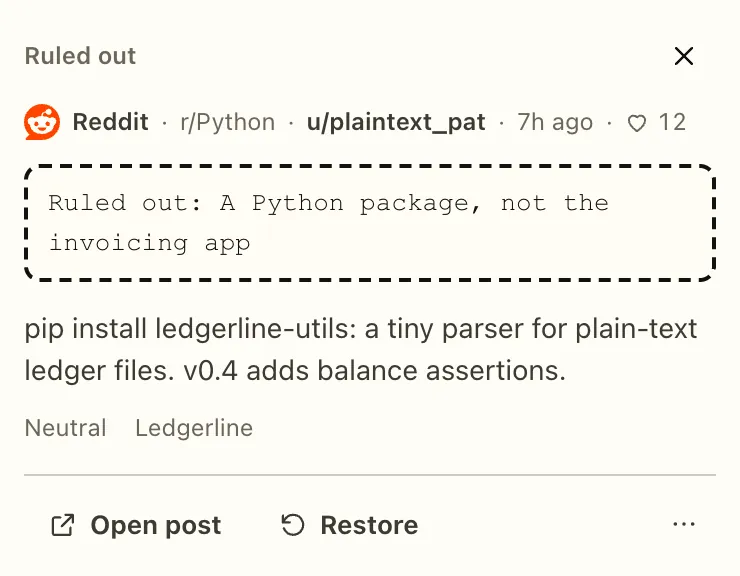
Names that are also libraries
Developer products often share a name with a package, a person or a common word. Describe your product in a line and say what it gets confused with, and the posts about something else are ruled out with a written reason. Open the tab to check the call and put one back.
Kept
Ruled out
Routing
Route each thread to the team that owns it
An alert can be limited to a category, so a bug report goes to the engineering channel and a comparison goes to marketing. Instant alerts and a daily digest go to Slack, Discord, Microsoft Teams or email.
A spike alert pings when mentions run far above normal, such as after a release or an outage thread.

API and MCP
Ask your tooling what developers are saying
Connect Claude, ChatGPT, Cursor or another agent over MCP, or call the REST API, and ask what needs a reply. Signed webhooks push each new mention to your own systems. It can mark posts done or for follow-up, and it never posts anything.
Try asking:
- What needs attention today?
- Which mentions reference our API or docs?
- What are developers comparing us against this week?
curl "https://sniffington.com/api/v1/mentions?categories=<bug-report-category-id>&sources=hn,x&order=urgency&limit=2" \
  -H "Authorization: Bearer $SCOUT_API_KEY"
{ "data": [
{ "source": "x", "author": "@marcusbuilds",
"text": "Ledgerline API returns 429 with no Retry-After header. The docs say it should.",
"category": "Bug report", "urgency": 71,
"reason": "API behaves differently from the docs: no Retry-After on 429" },
{ "source": "hn", "author": "tkaplan",
"text": "Ledgerline's webhook retries are great, but the docs don't say the signature header changed in v2.",
"category": "Bug report", "urgency": 58,
"reason": "Docs gap: the v2 webhook signature header rename is undocumented" }
] } // abridged
Public communities it searches
Hacker News stories and comments, Reddit posts and comments, GitHub issues and pull requests, Stack Overflow questions and answers, X posts, Bluesky including posts that only link to you, LinkedIn and YouTube, plus news sites.
Listening, not community management
Sniffington reads public conversations and tells your team about the ones that matter. It is not your community platform.
What it does
- Searches public communities for your product, docs and competitors
- Filters, labels and ranks each post, and rules out namesakes with a reason
- Sends alerts and digests to Slack, Discord, Microsoft Teams or email
- Gives you reports, a REST API, signed webhooks and an MCP server
What it does not do
- Post, reply, comment or like for you: you read the thread and answer as yourself
- Manage your accounts, schedule posts or hold a shared inbox
- Read private communities or chat servers
- Replace your community or support platform
A DevRel workflow: add, listen, filter, route
Add the product
Your product, its docs domain, technical terms and the tools it is compared with.
Listen
Sniffington searches the public communities on a schedule.
Filter
Relevant posts are kept and classified; the rest are ruled out with a reason.
Route to a team
To DevRel, support, product or an AI agent.
Questions
How can DevRel monitor technical conversations?
Add your product name, your docs domain and the phrases developers use to compare tools. Sniffington searches public developer conversations, sorts each kept post into a category such as Question, Bug report or Misinformation, and routes the urgent ones to Slack, Teams, Discord or email.
Which developer communities does Sniffington monitor?
Hacker News stories and comments, Reddit posts and comments, GitHub issues and pull requests, Stack Overflow questions and answers, X, Bluesky, LinkedIn, YouTube and news sites. A post whose link goes to your domain is kept as a mention even when the text never names you. The platforms page shows how each one is searched.
Can Sniffington find product and docs questions?
Yes. Posts that ask how something works are tagged Question. Filter to that category, or send it to a channel as an alert, and answer while the thread is open.
Can it detect bug reports?
Yes. Posts that report a problem are tagged Bug report with a one-line summary, and an alert can be limited to that category so it reaches the team that owns it.
Can it monitor competitor comparisons?
Yes. Keep competing tools in a Competitors group and phrases like "[tool] alternative" in a topic group. Threads where developers compare tools arrive tagged Comparison.
Does Sniffington search GitHub and Stack Overflow?
Yes. It searches the titles and bodies of public GitHub issues and pull requests, leaving out dependency bots, and Stack Overflow questions and answers. GitHub Discussions, issue comments and code are not searched.
Does it monitor Discord or Slack communities?
No. It searches the public sources on the platforms page. Chat servers and private communities are not searched.
Can alerts go to Slack or Teams?
Yes. Instant alerts, daily digests and spike alerts go to Slack, Discord, Microsoft Teams or email, and an alert can be limited to a category.
Can AI agents query the monitoring data?
Yes. The MCP server works with Claude, ChatGPT, Cursor, Codex, Gemini CLI and VS Code. It can list and filter mentions and mark them done. The REST API and signed webhooks are on every plan.
What happens when my product name is ambiguous?
Describe your product in a line and say what it gets confused with. Posts about something else are ruled out with a written reason, listed under Ruled out so you can check the call.
Does Sniffington replace a community management tool?
No. It finds public posts. It does not manage your accounts, schedule posts or hold a shared inbox.
Keep reading
- Hacker News monitoring for comments as well as stories
- Reddit monitoring: the threads people read when they google you
- GitHub monitoring for issues and pull requests that mention you
- Stack Overflow monitoring for the questions your docs should have answered
- Bluesky monitoring, including posts that only link to you
- Connect your coding agent to Sniffington over MCP
- The REST API, signed webhooks and the MCP server